
0
Skip to Content
Bill Noll Photography and Creative
Men
Women
Cities
Wellness
Food
Visuals
About
Bill Noll Photography and Creative
Men
Women
Cities
Wellness
Food
Visuals
About
Men
Women
Cities
Wellness
Food
Visuals
About
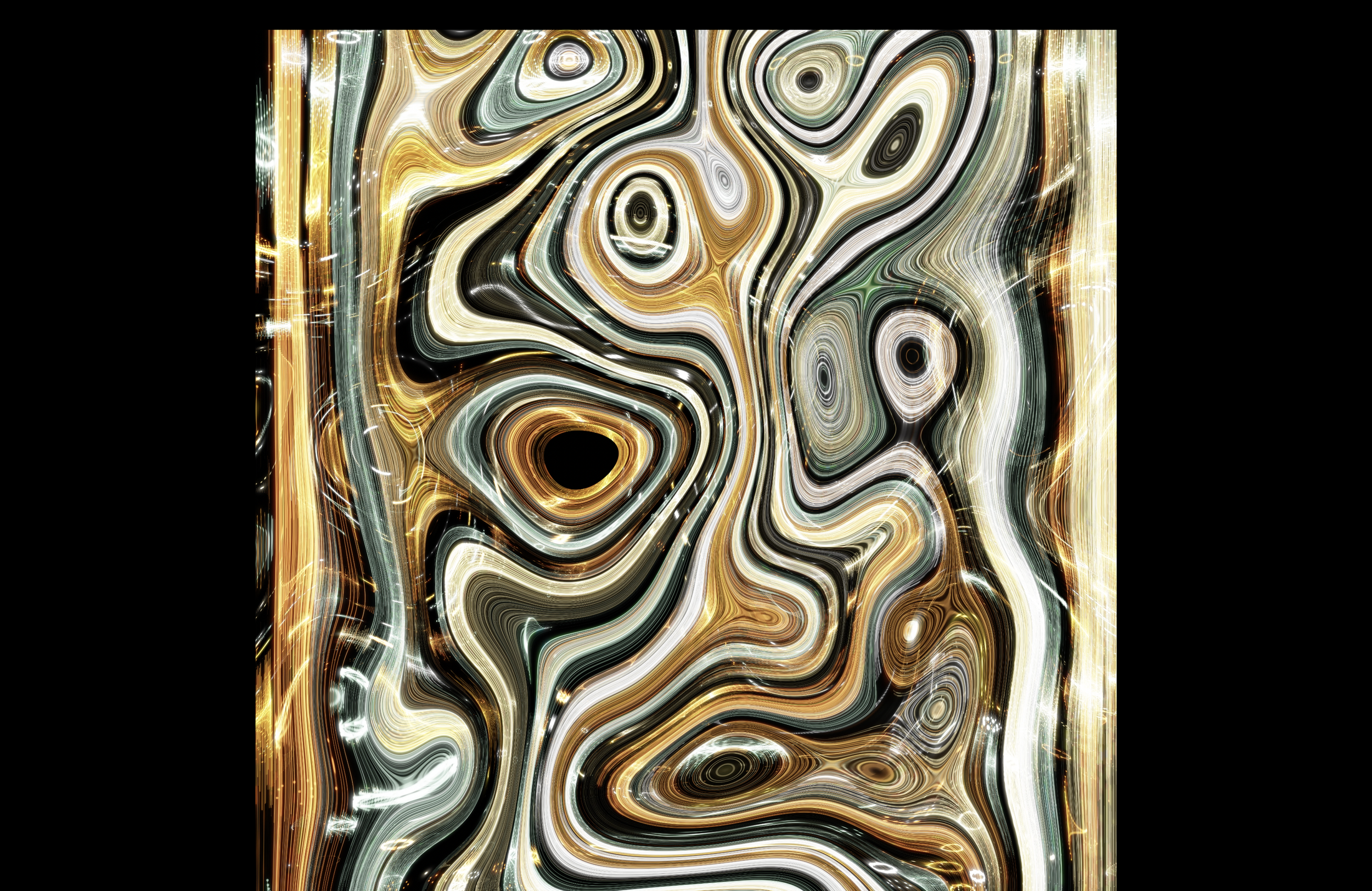
Chaotic Mixing

The marbled bands show a fluid that has been repeatedly stretched and folded. In 1984 Hassan Aref showed that even slow, orderly flows can mix chaotically, a process called chaotic advection, which now guides the design of microfluidi View fullsize

Chaotic Mixing The marbled bands show a fluid that has been repeatedly stretched and folded. In 1984 Hassan Aref showed that even slow, orderly flows can mix chaotically, a process called chaotic advection, which now guides the design of microfluidic devices. Fully developed turbulence is harder still. Richard Feynman called it the most important unsolved problem of classical physics, and a complete predictive theory of turbulence remains one of the outstanding goals of mathematical physics.
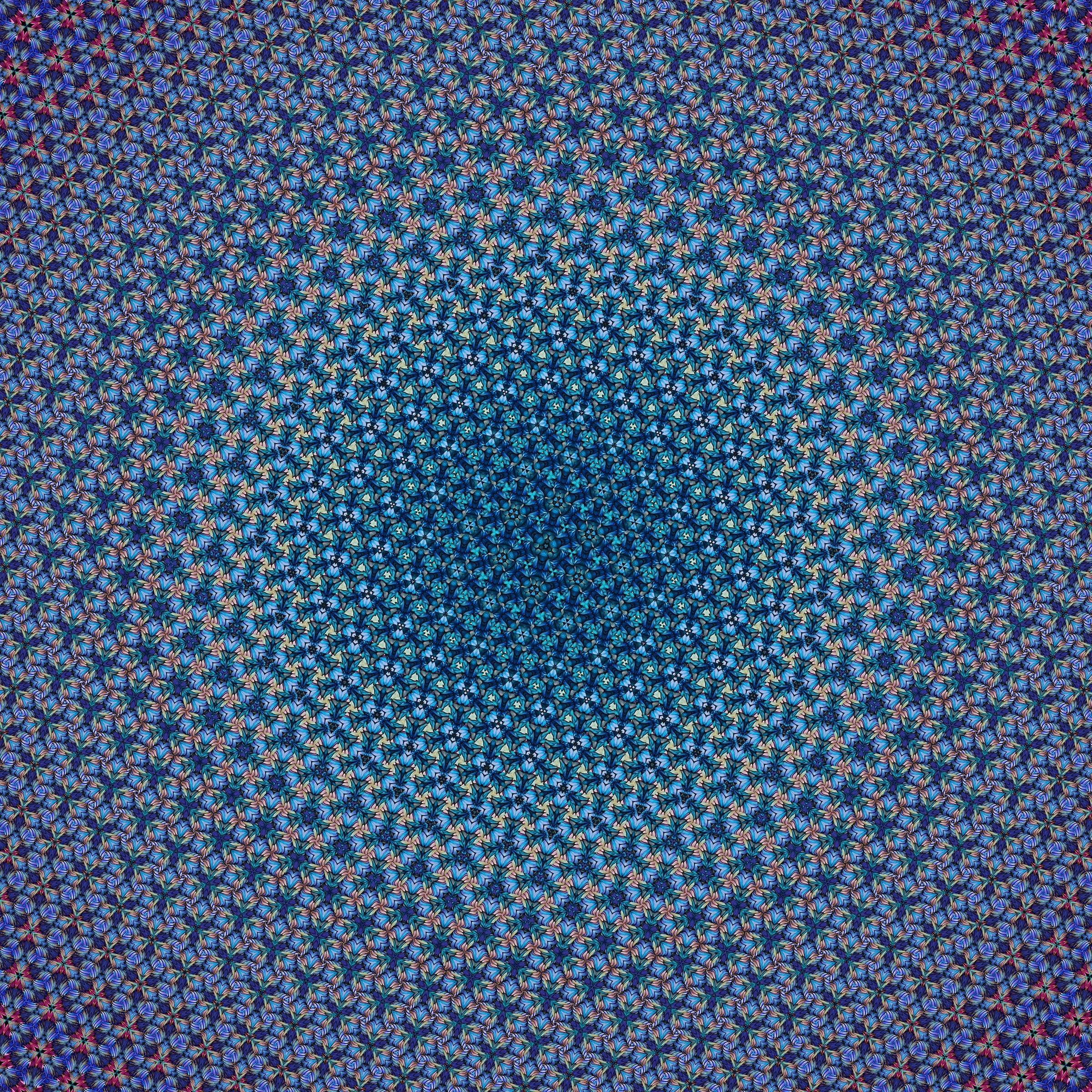
Wallpaper Group p31m

Every repeating pattern on a flat surface belongs to one of exactly seventeen symmetry types, a result proved by Evgraf Fedorov in 1891. This one, p31m, combines threefold rotations with mirror lines, yet some of its rotation ce View fullsize

Wallpaper Group p31m Every repeating pattern on a flat surface belongs to one of exactly seventeen symmetry types, a result proved by Evgraf Fedorov in 1891. This one, p31m, combines threefold rotations with mirror lines, yet some of its rotation centres sit off the mirrors. M. C. Escher learned the classification from George Pólya's 1924 paper and used it as a working grammar. In three dimensions the same question yields 230 crystal groups, and in four dimensions thousands, a catalogue still being explored by computer.
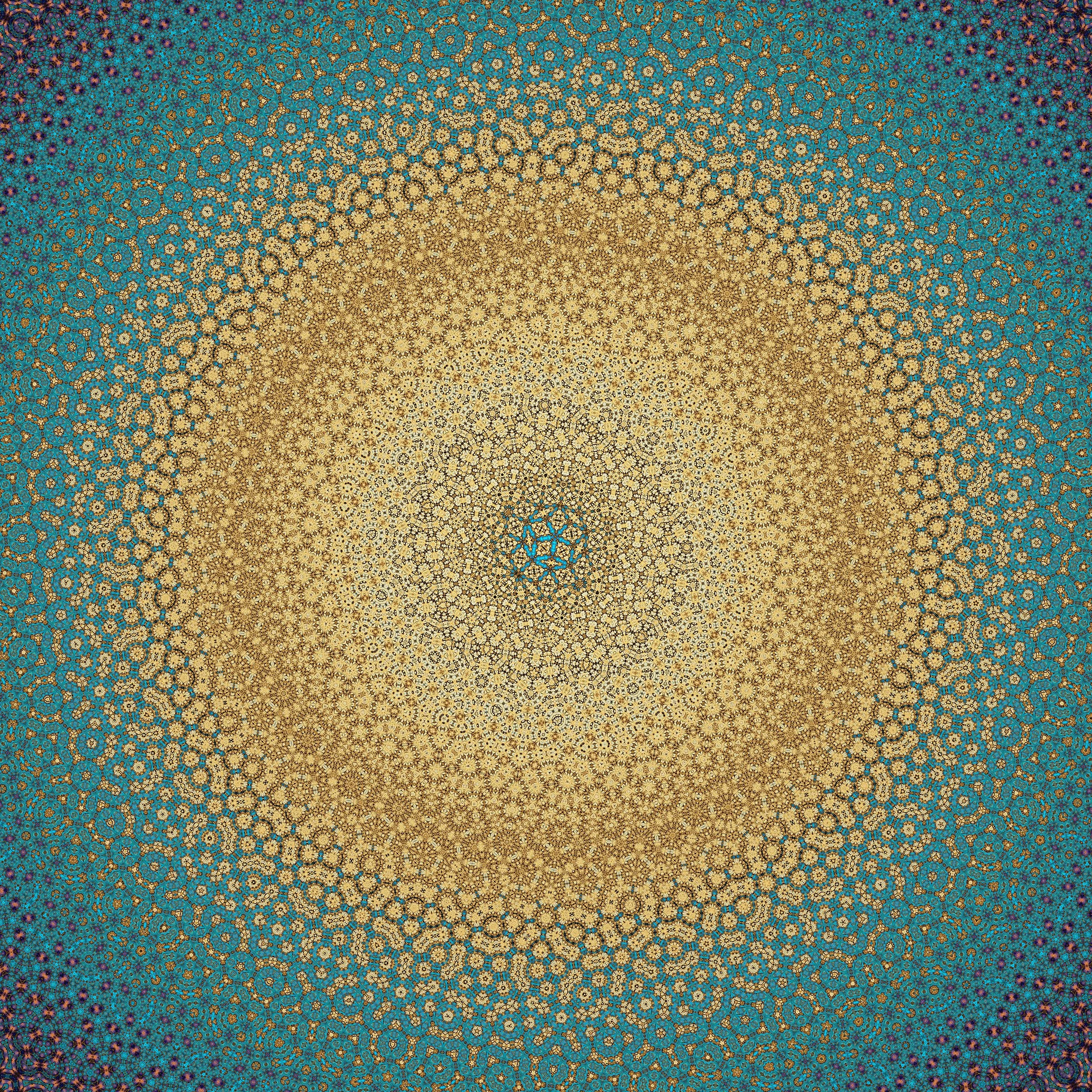
Penrose Rhombus Tiling

In 1974 Roger Penrose found that two rhombi, one thick and one thin, can cover the plane forever without the pattern ever repeating. The tiling carries a local fivefold symmetry that no periodic pattern can have, and the ratio View fullsize

Penrose Rhombus Tiling In 1974 Roger Penrose found that two rhombi, one thick and one thin, can cover the plane forever without the pattern ever repeating. The tiling carries a local fivefold symmetry that no periodic pattern can have, and the ratio of thick to thin tiles approaches the golden ratio. For fifty years mathematicians asked whether a single tile could do the same job. In 2023 an amateur, David Smith, found one, the "hat", and the search is now on for its physical counterparts.
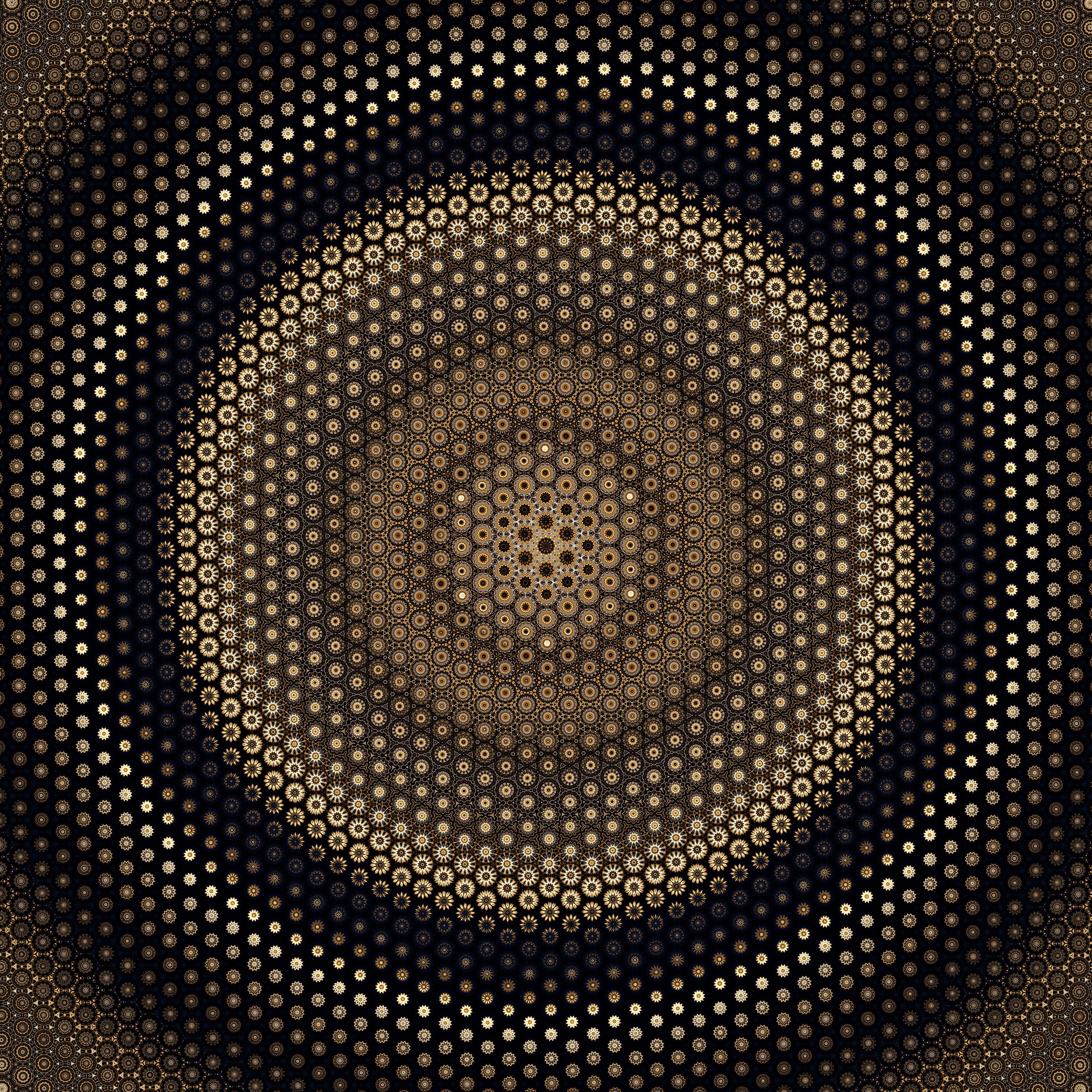
Rotation Group p3

This pattern has only one kind of symmetry: a turn of 120 degrees about any of its rotation centres. There are no mirrors, so the design has a handedness, like a left or right hand. It is the symmetry Escher returned to for many of View fullsize

Rotation Group p3 This pattern has only one kind of symmetry: a turn of 120 degrees about any of its rotation centres. There are no mirrors, so the design has a handedness, like a left or right hand. It is the symmetry Escher returned to for many of his interlocking creatures, after studying the Moorish tilework of the Alhambra in 1922 and again in 1936. Handedness of this kind matters in chemistry and biology, and engineers are now building chiral metamaterials that twist light in one direction only.
Kaleidoscope *333

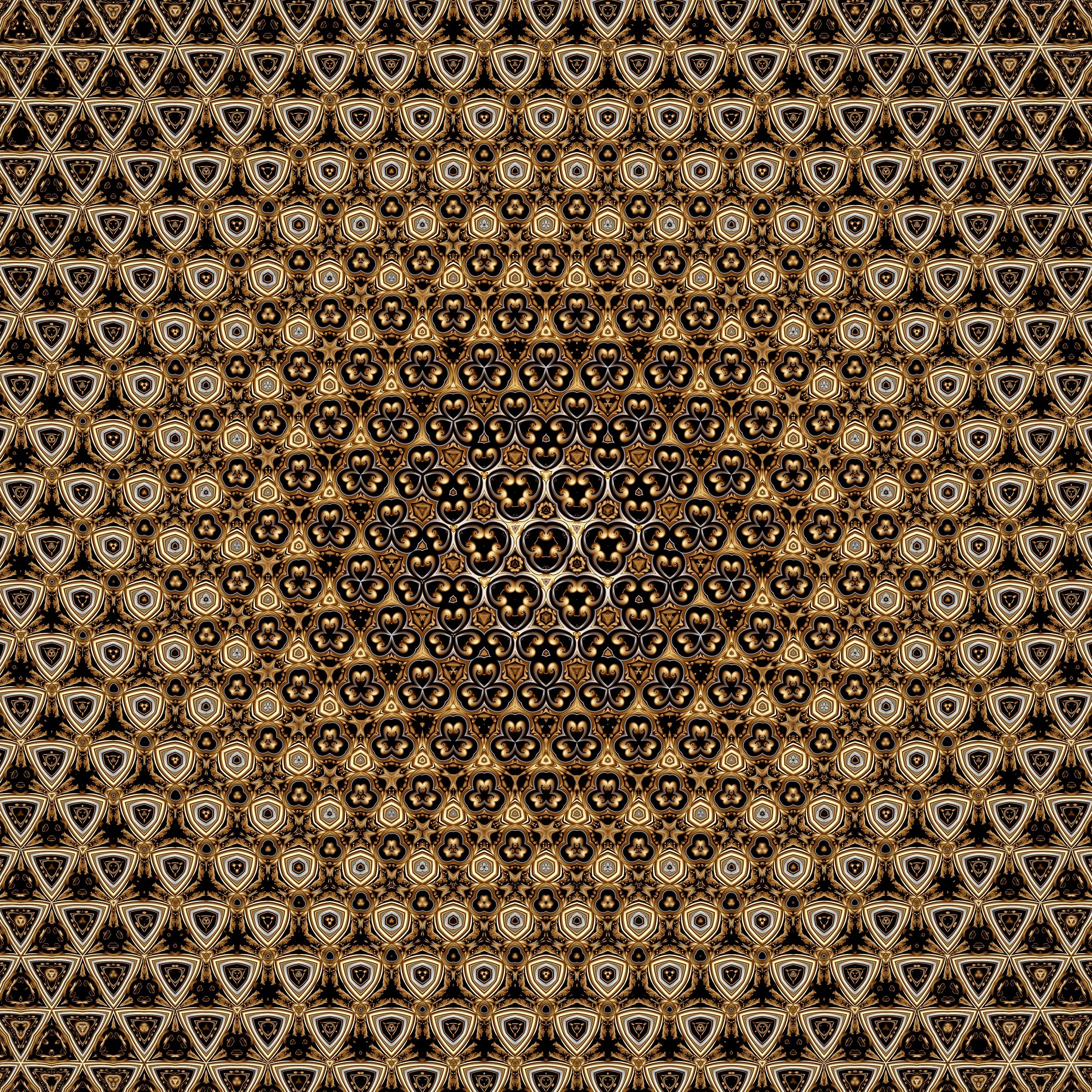
Place three mirrors in a triangle with 60-degree corners and the reflections fill the plane with exactly this symmetry, group p3m1, written *333 in John Conway's orbifold notation. David Brewster's 1816 kaleidoscope works on the sa View fullsize

Kaleidoscope *333 Place three mirrors in a triangle with 60-degree corners and the reflections fill the plane with exactly this symmetry, group p3m1, written *333 in John Conway's orbifold notation. David Brewster's 1816 kaleidoscope works on the same principle. Hexagonal lattices of this type are also the geometry of graphene. In 2018 physicists found that two graphene sheets twisted by about 1.1 degrees become superconducting, and the resulting moiré patterns are now one of the most active frontiers in materials physics.
Orbifold 3*3

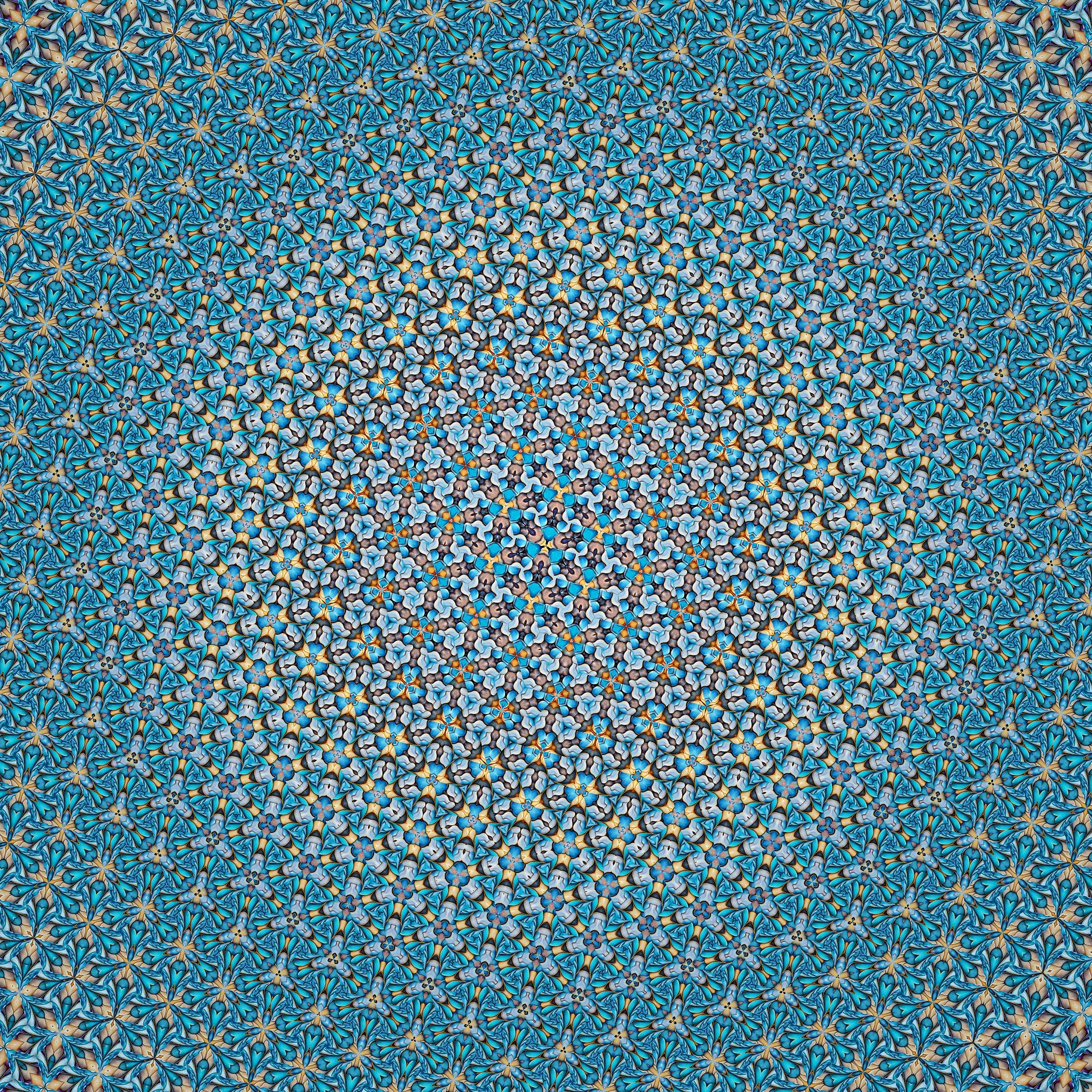
Fold this pattern along its symmetries until every repeated region lies on top of itself, and what remains is a small surface with one cone point and one mirrored edge. Conway and William Thurston called such objects orbifolds, and the View fullsize

Orbifold 3*3 Fold this pattern along its symmetries until every repeated region lies on top of itself, and what remains is a small surface with one cone point and one mirrored edge. Conway and William Thurston called such objects orbifolds, and the symbol 3*3 records this one completely. The idea reaches far beyond decoration: the same mathematics describes spaces that close back on themselves. Cosmologists use it to search the cosmic microwave background for matching circles, evidence that the universe itself might be a finite, folded shape.
Quasicrystal

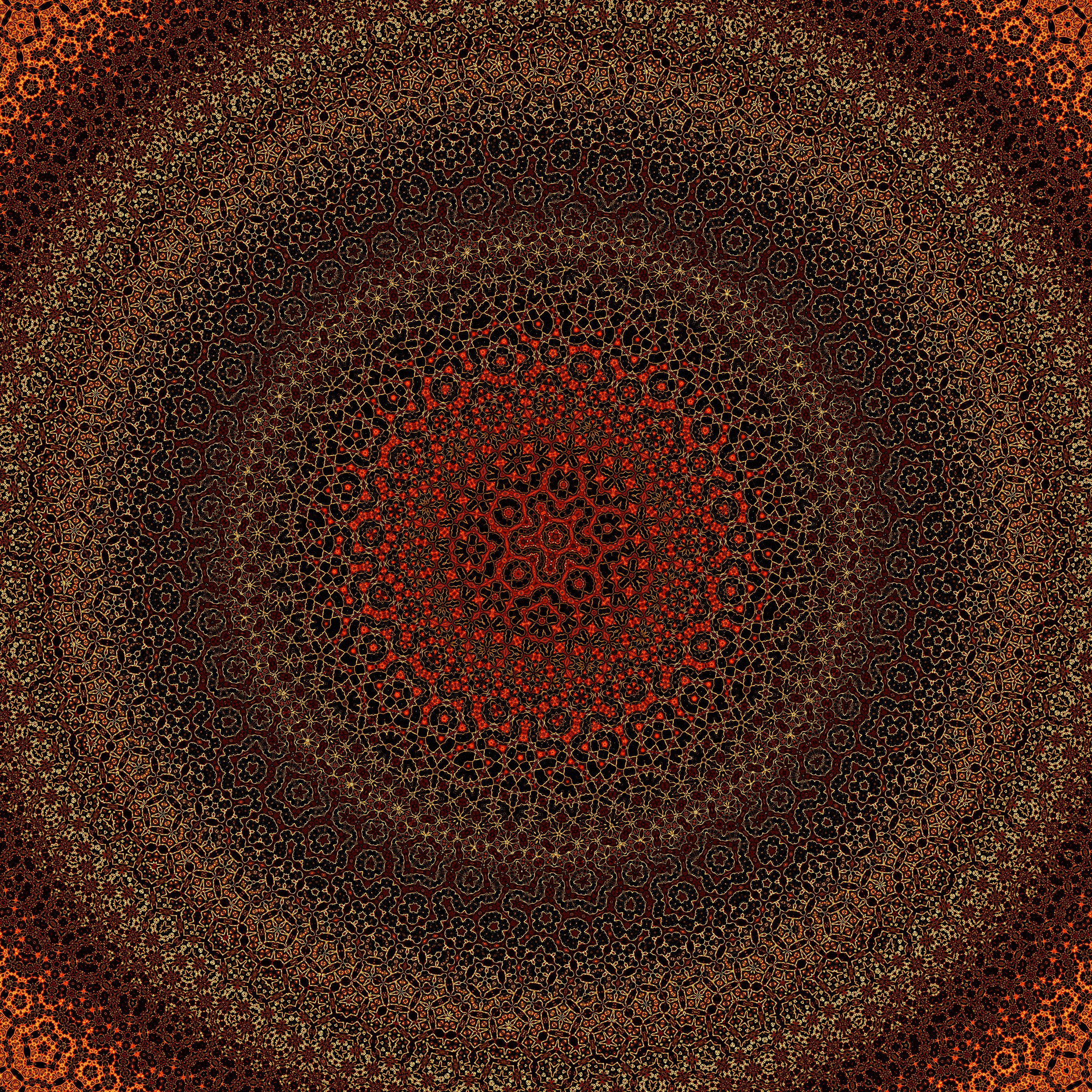
In 1981 Nicolaas de Bruijn showed that a Penrose tiling is a shadow: a slice of an ordinary cubic lattice in five dimensions, projected onto the plane. A year later Dan Shechtman saw the same forbidden fivefold order in a metal alloy, a View fullsize

Quasicrystal In 1981 Nicolaas de Bruijn showed that a Penrose tiling is a shadow: a slice of an ordinary cubic lattice in five dimensions, projected onto the plane. A year later Dan Shechtman saw the same forbidden fivefold order in a metal alloy, a discovery first dismissed and later awarded the 2011 Nobel Prize in Chemistry. Quasicrystals have since been found in a meteorite and in glass fused by the first atomic test. Whether nature uses higher-dimensional order in other, unnoticed ways remains open.
Snub Square Tiling

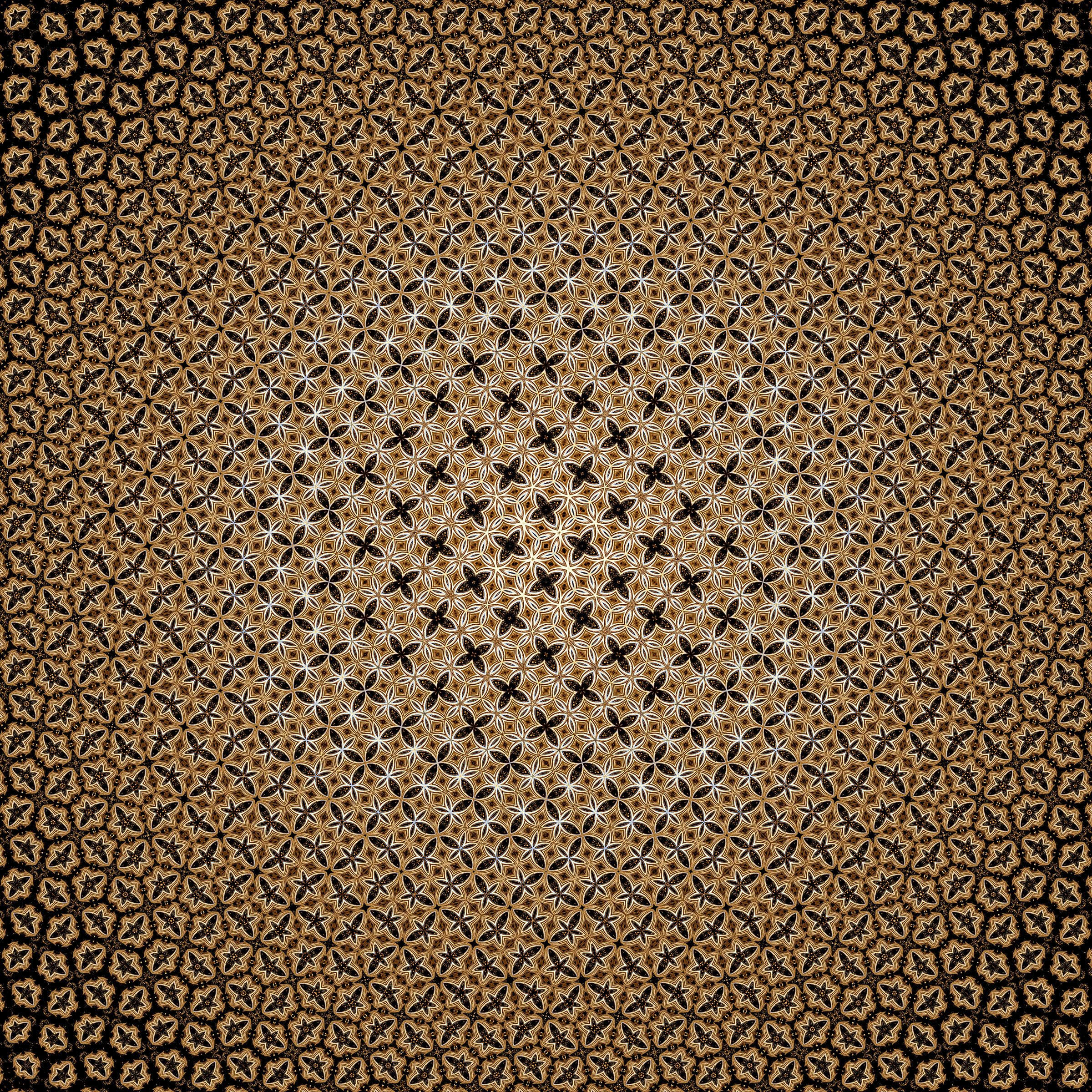
At every corner of this tiling, three triangles and two squares meet in the order triangle, triangle, square, triangle, square. Johannes Kepler listed it in 1619 in Harmonices Mundi, among the eleven tilings in which every vertex View fullsize

Snub Square Tiling At every corner of this tiling, three triangles and two squares meet in the order triangle, triangle, square, triangle, square. Johannes Kepler listed it in 1619 in Harmonices Mundi, among the eleven tilings in which every vertex looks the same. The slight twist of the squares gives it a rotational flow that Escher would have recognised. The same arrangement appears in self-assembling nanoparticles and alloy crystals, where it is a close relative of twelvefold quasicrystals now being studied as new materials.

Chaotic Mixing

The marbled bands show a fluid that has been repeatedly stretched and folded. In 1984 Hassan Aref showed that even slow, orderly flows can mix chaotically, a process called chaotic advection, which now guides the design of microfluidi
Wallpaper Group p31m

Every repeating pattern on a flat surface belongs to one of exactly seventeen symmetry types, a result proved by Evgraf Fedorov in 1891. This one, p31m, combines threefold rotations with mirror lines, yet some of its rotation ce
Penrose Rhombus Tiling

In 1974 Roger Penrose found that two rhombi, one thick and one thin, can cover the plane forever without the pattern ever repeating. The tiling carries a local fivefold symmetry that no periodic pattern can have, and the ratio
Rotation Group p3

This pattern has only one kind of symmetry: a turn of 120 degrees about any of its rotation centres. There are no mirrors, so the design has a handedness, like a left or right hand. It is the symmetry Escher returned to for many of
Kaleidoscope *333

Place three mirrors in a triangle with 60-degree corners and the reflections fill the plane with exactly this symmetry, group p3m1, written *333 in John Conway's orbifold notation. David Brewster's 1816 kaleidoscope works on the sa
Orbifold 3*3

Fold this pattern along its symmetries until every repeated region lies on top of itself, and what remains is a small surface with one cone point and one mirrored edge. Conway and William Thurston called such objects orbifolds, and the
Quasicrystal

In 1981 Nicolaas de Bruijn showed that a Penrose tiling is a shadow: a slice of an ordinary cubic lattice in five dimensions, projected onto the plane. A year later Dan Shechtman saw the same forbidden fivefold order in a metal alloy, a
Snub Square Tiling

At every corner of this tiling, three triangles and two squares meet in the order triangle, triangle, square, triangle, square. Johannes Kepler listed it in 1619 in Harmonices Mundi, among the eleven tilings in which every vertex

© Bill Noll